
Digital Library of the Middle East (DLME) and Its Metadata
Guidelines for the Assignment:
The DLME Metadata Assignment is an assignment in one step. It builds upon the work we did in class on February 7th.
This assignment can be done alone or in pairs (either the ones from class or new ones).
This exercise has two main elements: (1) illustrating how federated libraries can help us understand different kinds of relationships between objects found in global collections and (2) exploring the discoverability of the items given their metadata.
Identify two or three items from the [Digital Library of the Middle East]
Since I’m interested in sea shells(mainly bc of their beautiful rainbow shade reflected under sunshine), I set out searching “shell”. Then I found an item called “Tridacna shell”.
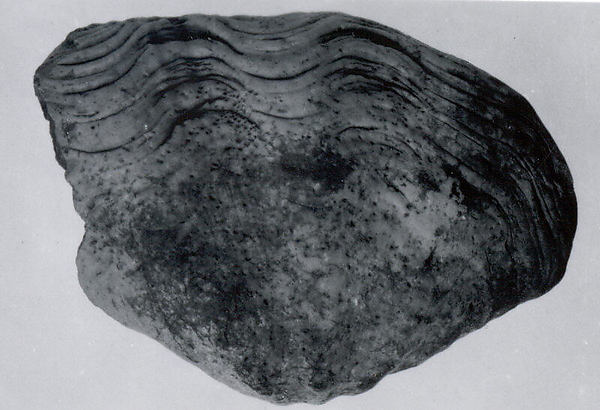
Then I went on searching “Tridacna” in the metadata website, and found two other items that are shells, but are quite different.
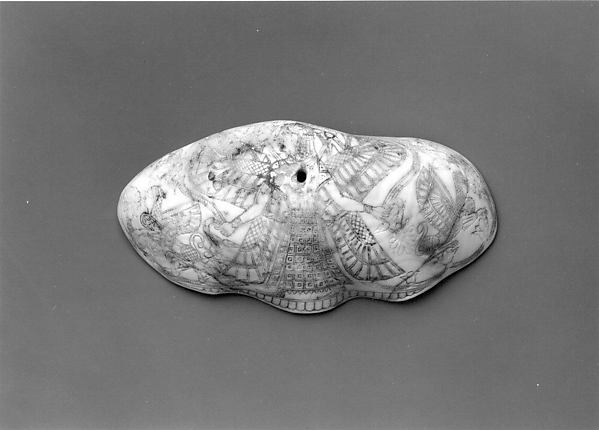

Comparison of metadata
Here are their information:
| Title | Type | Date | Geographic region | Time period | Medium |
|---|---|---|---|---|---|
| Tridacna shell | Shell-Ornaments | 800 - 600 BC | Levant/Tawilan | Iron Age | Shell (Tridacna squamosa) |
| Shell engraved with winged female deity, sphinxes, and lotus plants | Shell-Ornaments | 700 - 600 BC | Levant | Iron Age II | Shell (Tridacna squamosa) |
| Fragment of a shell with a sculpted female head | Shell-Vessels | 700 - 600 BC | Levant/Mesopotamia | Iron Age II | Shell (Tridacna squamosa) |
They are similar in that they are all made of the same material–Tridacna squamosa is a species of giant clam found in the Indo-Pacific region. It is known for its large size and distinctive scalloped shell, which is highly prized for its beauty and durability. Tridacna squamosa has been used for thousands of years by humans for a variety of purposes, including as a food source, a source of pearls, and as a material for making shell products.During the Iron Age, Tridacna squamosa shells were used extensively by coastal communities in Southeast Asia for making a variety of tools and ornaments, including adzes, scrapers, and jewelry. The shells were also traded over long distances, with some specimens found as far away as the Mediterranean. Today, Tridacna squamosa remains an important cultural and economic resource in many parts of the world, and continues to be used in a wide range of traditional and modern applications.Yet it is surprising to me that despite made of the same material, theit texture look quite different.
I was wondering what ‘s the meaning of shell-vessel and shell-ornament. As I looked up, I understood that vessel shells are used as containers mainly for cosmetics. On the contrary, shells with more sophisticated shapes like trumpet shells are used as ornaments, for decoration purpose.
This further research also solved my questions about why the two later found shell objects have names related to feminism, expecially the sculpted fragment. Here I argue: Shells used as cosmetic containers and shells used as ornaments differ in their purpose and appearance. Shells used as cosmetic containers are generally thinner and more flat, with a practical and functional design that allows them to hold and store cosmetics or other small items. They are often made with a practical use in mind and may have simple, utilitarian shapes.On the other hand, shells used as ornaments are typically more decorative and sophisticated in appearance, with intricate designs and shapes that are meant to be admired and appreciated for their aesthetic qualities. These shells may be sculpted into the shape of a woman’s face or have intricate patterns carved into their surfaces. They are often associated with femininity and beauty, and are used to enhance the visual appeal of a space or to add a touch of elegance to an outfit or accessory.
Besides their comparisons, these three items are similar in that they’re all most likely made in Iron age, originated from the region of Levant. I was in owe with the delicacy of the craftsmanship of these shells. The patterns carved on them are very detailed, and you can tell that the craftsman is very experienced. And it was made before 600 BC. I wonder what they used to carve these patterns, especially the technique to make the sculpted woman face. What equipment were they using at the iron age? Pure knife? Dp they have tools like scrubs to smooth the surface?
How complete or certain is the metadata?
Considering that there might be data loss when extracting data from the original database to this metadata set, I went to the contributor’s website– “Metropolitan Museum of Art”, and compared the three items. I found a category from the contributor’s website that s missing in the metadata : “Culture”. On the page for “Tricadacna shell” , it specified its culture as “Edomite”. However, this items is documented in way less detail compared to the other two. The other two each has a paragragh describing their cuture, geographic origination, the meaning of the appearance/aesthetics.
Here’s the description of “Fragment of a shell with a sculpted female head”:
“The shell of a species of large clam (Tridacna squamosa), native to the Indian Ocean, the Red Sea, and the Persian Gulf, was used to carve a distinctive type of cosmetic container during a short period from the late seventh to the early sixth century B.C. More than a hundred containers of this type survive, and have been found throughout the Near East and Mediterranean, as far east as Iran and as far west as Italy. Unworked shells have been found in Palestine and Transjordan, suggesting that the workshops where these containers were manufactured were located in these regions. This fragment of a cosmetic container preserves the thick hinge of the shell, which was carved as the three-dimensional head of the figure whose body was incised on the shell’s outer surface. The figure’s very large eyes are outlined with double incised lines, and the pupils are highlighted with drilled holes. The other features are simplified, such as the small mouth represented by two incised lines. A ridge at the forehead suggests a headband, which wraps around the back of the head, holding back the hair which is represented as individual feather-like hatched locks. Traces of a decorative border can be seen at the lower edge of the hair, which would have continued on the figure’s garment when the container was complete.”
Here’s the description of “Shell engraved with winged female deity, sphinxes, and lotus plants”:
“The shell of a species of large clam (Tridacna squamosa), native to the Indian Ocean, the Red Sea, and the Persian Gulf, was used to carve a distinctive type of cosmetic container during a short period from the late seventh to the early sixth century B.C. More than a hundred containers of this type survive, and have been found throughout the Near East and Mediterranean, as far east as Iran and as far west as Italy. Unworked shells have been found in Palestine and Transjordan, suggesting that the workshops where these containers were manufactured were located in these regions. This remarkably preserved shell bears elaborate incised decoration on the outer surface. A four-winged figure wearing an intricate embroidered or woven garment holds floral branches in both hands, and lotus flowers and buds sprout from her shoulders. Two small winged sphinxes flank her, each surrounded by more branches which sprout buds, blossoms, and palmettes. Decorative patterning covers much of the surface, including the wings of the central figure and the sphinxes, their cross-hatched hairstyles, the stems of the branches, and a border that runs along the bottom of the scene. On the inner surface of the shell, a border of triangles and another row of blossoms and buds has been incised around the edge. A hole pierces the shell at the chest of the central figure.”
What other kinds of metadata can you find about the objects? What kinds of metadata categories might you add that would make the items more discoverable?
I googled “Iron age archaeology digital library”,
and found the metadata website “Atla Digital Library”https://dl.atla.com/concern/works/xd07gv54m?locale=en.
The Atla Digital Library is an online platform that brings together various digitized collections from around the world. These collections come from libraries, religious institutions, and other organizations that gather and preserve materials such as texts, records, photographs, maps, recordings, and more. With its search feature, the Atla Digital Library allows users to easily access and explore these materials, which are of great significance to anyone interested in studying, teaching, or researching historical and archival content in the fields of religion and theology.The layout of this digital library is very similar to that of Digital Libraries of the Middle East. It also allows search by categories, the slight difference is that the items collected in Atla is largely from academic institutes, colleges rather than museums and galleries.
To make shell items more discoverable, several metadata categories could be added. These categories might include:
Feminist Design: A metadata field that indicates whether a shell product features a design that is explicitly feminist in nature, such as a carved image of a woman or a pattern associated with a matriarchal culture.
Cultural Origin: A metadata field that identifies the cultural or ethnic group that created the shell product, as different groups may have had unique artistic styles and design motifs. Here I may specify the culture origin as Edomite.
Date and Location: A metadata field that provides information on where and when the shell product was found, which can help researchers understand its historical and cultural context.Here I need to specify the date to iron age.
By adding these metadata categories, researchers and historians interested in feminist iconography in Iron Age shell products would be better able to discover and analyze relevant materials.
Reference 1: “Tridacna squamosa.” Wikipedia, Wikimedia Foundation, 17 Feb. 2023, https://en.wikipedia.org/wiki/Tridacna_squamosa.